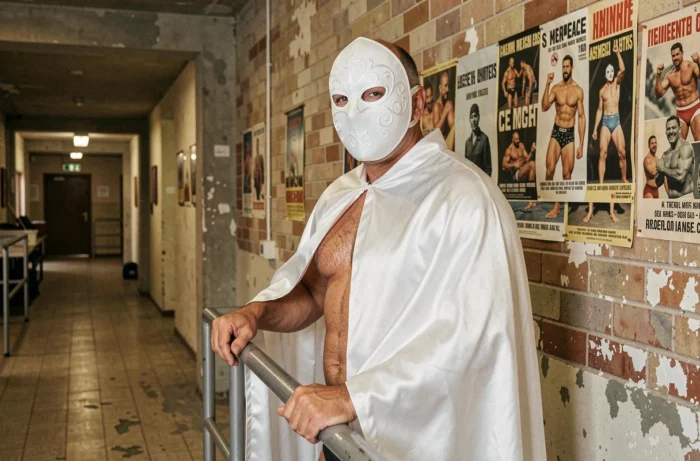
When looking at the archives of French wrestling from the 1950s-1960s, one detail stands out even before the technique or the holds: the white mask, complete and flawless. The White Angel established this accessory as a visual code in its own right, far beyond the ring. His journey explains why the wrestling mask remains, in France, associated with a figure of a television vigilante rather than just a fighter’s disguise.
The mask as a ring tool: what masked wrestlers had to solve in France
Before the White Angel, French wrestling operated on a simple principle: wrestlers were recognized by their face, their build, their name. The mask posed a concrete problem for gala organizers. A masked wrestler could not rely on his local reputation to fill a venue. The mask itself had to become the reputation.
The White Angel solved this constraint with a radical choice. Everything was white, from the mask to the cape, with no variation. This visual uniformity created an instantly recognizable character, even on the small black-and-white screens of the time. Spectators did not need to know his real name to recognize him.
Here we find a logic that came from Mexico and passed through Spain, where masked luchadores had already understood that the mask is not an accessory but a character in itself. By studying the journey of the White Angel in wrestling, we see how this cultural import was adapted to the French post-war context, where the public sought positive, readable, reassuring figures.
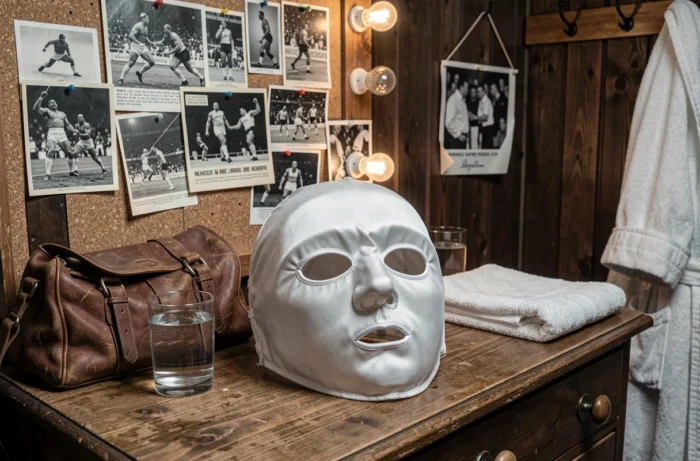
White Angel and French television: why the mask exploded on screen
Wrestling reached its peak television popularity in France between the late 1950s and the 1960s. The White Angel appeared at the Cirque d’Hiver one January evening in 1959, commented on by Roger Couderc, the same man who would become the voice of French rugby. This is not insignificant.
The white mask functioned as a television signal before being a combat accessory. On a black-and-white screen, in a tight frame, the contrast between the immaculate mask and the rest of the ring immediately captured attention. Viewers who knew nothing about wrestling could follow the story: the all-white character was the good guy.
Roger Couderc presented the White Angel as Venezuelan, adding a layer of exoticism to the mystery of the mask. In reality, the wrestler’s name was Francisco Pino Farina, of Spanish origin. This narrative construction, where the mask allows for the reinvention of an identity, worked because television amplified the mystery. One never saw the face, one did not know the true story, and that was precisely what fueled the fascination.
The mask as an autonomous television character
Recent research on French television memory reinterprets the White Angel as a prototype of the “masked television hero.” This reading goes beyond simple nostalgia for wrestling. The mask became a screen icon, not just a ring accessory. This is the difference between a masked Mexican wrestler, known in his local arena, and a character broadcast in millions of French households on Saturday nights.
Women would kneel as he passed, and people would kiss his hands. This fan behavior, documented by contemporary chroniclers, resembles that of a movie star audience rather than wrestling enthusiasts. The mask allowed for this transformation of the wrestler into a popular star.
Masked wrestling in France: the mystery of simultaneous appearances
A concrete aspect of the White Angel phenomenon deserves attention: several wrestlers wore the same white mask in different cities on the same night. This point, often mentioned with amusement, reveals a precise mechanism for managing the character.
The White Angel was not an individual but a franchise. The mask made this multiplication possible, as no one could compare faces. This practice posed concrete questions for organizers:
- The build and wrestling style had to remain consistent from one wearer to another, lest they disappoint a loyal audience that could spot technical differences
- The outfit had to be strictly identical (all white, cape, mask), which imposed rigorous clothing control across different galas
- The narrative of the match had to follow the same moral scheme: the White Angel punishes the “bad guys,” he never loses out of cowardice, he embodies spectacular justice
This logic of a shared character, made possible only by the mask, anticipates what we find today in franchises of fictional characters. The mask was not a disguise; it was a protocol.
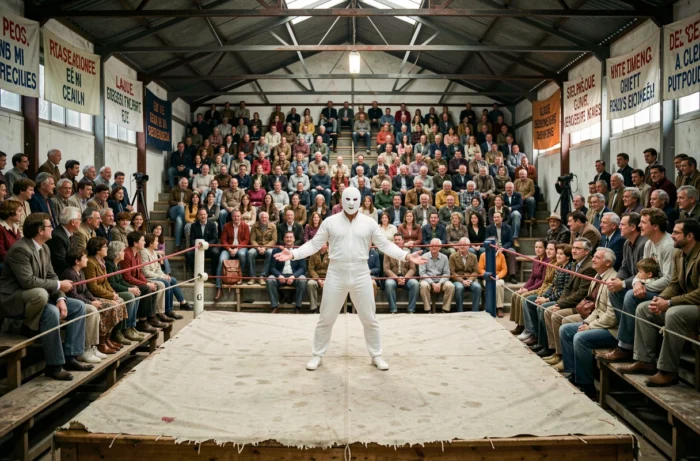
Legacy of the wrestling mask in French popular culture
The White Angel has left the rings, but the mask he popularized continues to function as a cultural landmark in France. When discussing French wrestling with generations who have never seen a match, it is the white mask that comes to mind first. Not a hold, not a ring name, not a comment from Roger Couderc: the mask.
This persistence can be explained by a mechanism that cultural history researchers describe as a continuum between stage mask and identity mask. France has a long tradition of masks (theater, carnival, aristocratic masked balls), and the White Angel inscribed wrestling into this French cultural lineage of the mask. The character did not come from nowhere: he grafted onto a pre-existing imaginary, that of the mask as a vector of transformation and protection.
What distinguishes the White Angel from other masked wrestlers of his time is that his mask became a prototype of media persona. A positive, readable, protective identity, broadcast by television in a country that was rebuilding. Opinions vary on whether other masked wrestlers could have achieved the same status without television, but the fact remains that the white mask established a model that no one has reproduced with the same impact.
French wrestling has never regained the popularity of that period. The mask of the White Angel remains tied to a specific time, a specific medium, a specific collective need. It is this conjunction, and not just the talent of a wrestler, that has etched the white mask into French memory.