The fashion trends of 2024 are not just a list of pieces spotted on the runways. They reflect a deeper change in how to compose a style for everyday life: less volume purchased, more reworked pieces, and a textile vocabulary that now incorporates concrete environmental constraints. Understanding these mechanisms allows for the construction of a wardrobe that lasts several seasons without looking dated.
Upcycled Fashion: The Structuring Trend That Runways Don’t Show
Textile upcycling involves transforming existing garments or dormant stock into new pieces, without reverting to the production of raw materials. This approach goes beyond mere ecological gestures.
According to the 2024 report from Fortune Business Insights, the upcycled fashion market has seen significant growth since 2023. Brands are developing reconstructed collections from unsold items, and second-hand retailers are incorporating upcycled creations into their assortments. The demand is particularly strong among 18-34 year-olds.
For a unique everyday style, upcycling offers an advantage that classic ready-to-wear cannot replicate: each reworked piece is by definition singular. Whether it’s a pair of jeans made from panels of two different models or a jacket reconstructed from fabric scraps, the result exists as a one-of-a-kind item.
Specialized creators offer this type of pieces, and home customization (dyeing, cutting, adding embroidered patches) remains the most accessible method to achieve this look with an existing wardrobe. Inspiration abounds on Le blog de Bango mode, which compiles ideas for refreshing outfits without starting from scratch.

Fibers and Eco-Textile Design: What Regulations Change in 2024
The European strategy for sustainable and circular textiles, gradually implemented since 2024, directly modifies the composition of garments available in stores. Its stated goal: to reduce the volumes of textiles put on the market and increase the share of sustainable or recycled fibers in collections.
In practice, this translates to a reduction in difficult-to-recycle synthetic blends. Brands anticipating this regulation favor mono-materials (linen, organic cotton, wool) and certified recycled fibers. A mono-material garment is easier to recycle than a polyester-cotton blend, which influences production choices.
For the composition of an everyday style, this evolution has a direct consequence: pieces made from unblended natural materials are gaining ground in accessible collections. Linen, once confined to summer outfits, appears in structured blazers and wearable mid-season trousers. Recycled cotton improves its durability over washes thanks to new spinning processes.
Reading Labels Differently
The composition listed on the label becomes a true criterion for sustainable style. Here are some concrete guidelines to guide a purchase:
- A piece composed of at least one main fiber (more than half of the composition) will perform better over time than a blend of three different materials in equal parts.
- Certifications like GOTS (organic cotton) or GRS (recycled fibers) guarantee a verifiable specification, not just a marketing argument.
- A sufficiently dense weight on a cotton t-shirt indicates better longevity than a thin and translucent fabric, even if the label states “100% cotton” in both cases.
Building a Cohesive Color Palette by Season
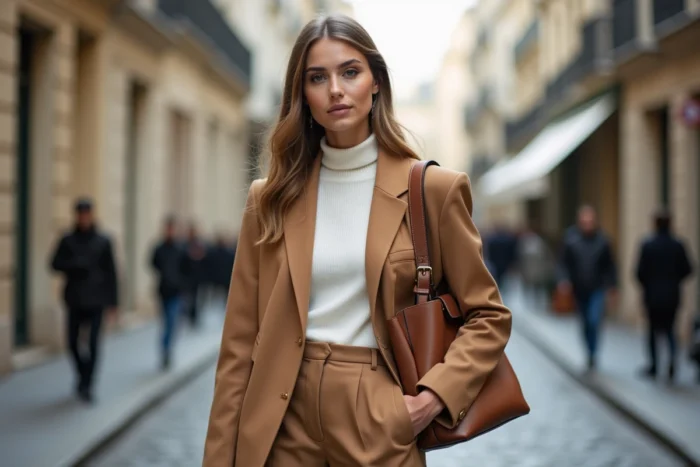
The color trends for 2024 oscillate between earthy tones (brown, camel, rust) and brighter accents (cherry red, cobalt blue). Reproducing this palette without a taste faux pas requires understanding a simple principle: an everyday wardrobe works on a maximum of three colors per outfit.
The first level is the neutral base. Replacing the systematic black with dark brown or navy blue is enough to alter the overall silhouette without changing pieces. The second level is the accent color, worn on a single visible element (a scarf, a pair of shoes, a bag). The third level, optional, is the pattern: stripes, polka dots, or checks that incorporate one of the first two colors.
Adapting the Palette to One’s Morphology and the Season
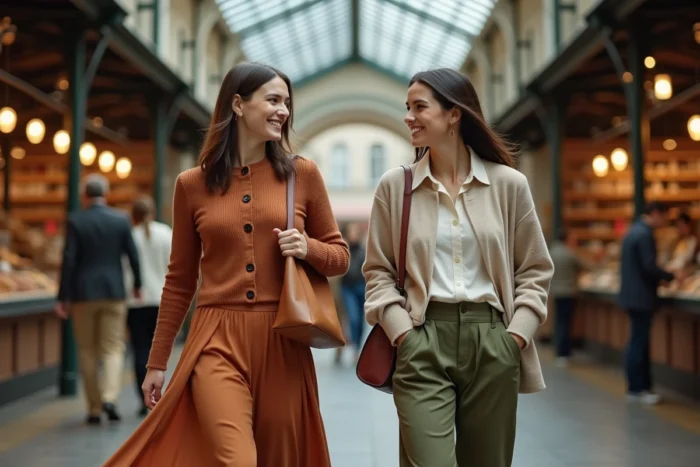
Warm colors (rust, camel, butter yellow) work better in autumn and spring, worn in upper pieces. Cool colors (slate gray, blue) integrate more naturally in winter. This is not an absolute rule, but a starting point that simplifies associations.
Body shape plays a role in distribution: placing the most intense color on the area of the body to highlight naturally draws the eye. A colorful top over neutral bottoms visually broadens the shoulders. The reverse elongates the silhouette.
Accessories and Street Style: The Fastest Differentiation Lever
Changing an accessory alters the perception of an outfit more than changing an entire garment. The street style trends of 2024 confirm this logic: oversized bags, metallic shoes, visible socks in loafers or sandals.
The appeal of these elements for an everyday style lies in their cost and versatility. A pair of silver loafers transforms straight jeans and a plain sweater into a standout outfit. Colorful socks (red, off-white) visible above low shoes add a detail without heavy investment.
- A structured medium-sized bag works from the office to the weekend. The oversized format remains more suitable for casual outfits or layered looks.
- Gold metal jewelry, worn in measured accumulation (two or three bracelets, not ten), adds texture to a monochrome outfit.
- A visible belt, worn over a jacket or cardigan rather than in the pants’ loops, restructures the silhouette effortlessly.
The fashion trends of 2024 reward coherence more than accumulation. Three well-matched pieces with a unique accessory create more impact than an outfit made up of five stacked trends. The true lever for a unique style remains the ability to choose few but well, relying on sustainable materials and mastered color combinations.