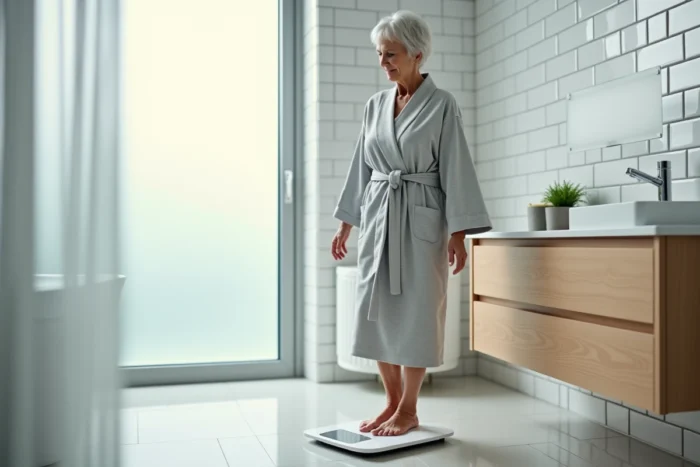
You step on the scale one morning and read 28% body fat. The next day, after a coffee and a diuretic, the screen shows 25%. A three-point difference in twenty-four hours, without any change in physique. For a senior monitoring their muscle mass or following a rehabilitation program, this type of variation poses a real trust issue in the device.
Why integrated equations skew results after 70
Most consumer body fat scales come equipped with algorithms developed from populations of young, healthy adults. Therefore, the percentages of body fat and muscle mass are calibrated for a profile that does not correspond to that of a 75-year-old.
In seniors, water distribution changes. Body water decreases with age, tissues change, and common pathologies (heart failure, kidney disorders) further disrupt the balance. After 70, the accuracy of body fat estimates drops significantly, especially in frail or sarcopenic individuals, as the equations are no longer validated for these profiles.
Several geriatrics teams recommend not to rely on the absolute percentages displayed by commercial scales in these situations. This is far from a mere precision whim: an incorrect figure can lead to underestimating actual muscle loss or, conversely, trigger unwarranted concern.
To understand what concretely influences the reliability of a body fat scale, one must first accept that the device measures electrical resistance, not directly muscle or fat. Anything that alters tissue conductivity changes the result.
Hydration and diuretic treatments: the factor seniors are most affected by
It is known that one should weigh themselves under stable conditions. In practice, for an elderly person on diuretic treatment, this stability is hard to achieve. The variability related to hydration is much more pronounced in seniors than in the general population.
A diuretic pill taken in the morning can cause the displayed weight to fluctuate by several hundred grams within a few hours and alter the resistance measured by the electrodes. Caregivers in geriatrics regularly observe this: absolute numbers can sometimes become inconsistent from one day to the next.
Standardizing measurement to obtain an exploitable trend
The only reliable approach is to create a rigid weighing protocol:
- Weigh yourself at the same time every day, ideally in the morning on an empty stomach, after using the restroom
- Wear minimal clothing and place bare, dry feet flat on the electrodes
- Space the weighing at least two hours after taking a diuretic or having a large meal
- Never interpret a single measurement in isolation, but observe the trend over three to four weeks
Only the trend over several weeks has real value for monitoring body composition in a senior. A single peak or trough says nothing about muscle evolution.
Foot electrodes and sarcopenia: a blind spot for upper limbs
The majority of consumer scales operate with electrodes located only under the feet. The low-intensity current travels up the legs and lower trunk, and then the device extrapolates an overall body composition.
The problem is concrete: foot electrode scales significantly underestimate sarcopenia in the upper limbs. In a senior whose arms and shoulders are losing muscle mass, the device may display a reassuring balance simply because it does not “see” the upper body.
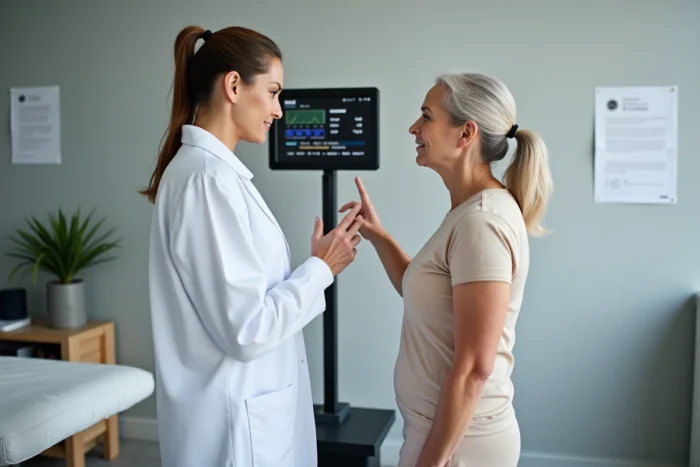
Professional segmental bio-impedance analyzers, which use electrodes on the hands and feet, provide a more complete picture. In hospitals or rehabilitation centers, this type of device is preferred by nutrition and geriatrics teams. For home use, we remain limited by the technology available on the market.
Body fat scale for seniors: concrete criteria before purchase
Rather than seeking the most accurate device in absolute terms (no consumer model rivals a clinical examination), it is beneficial to choose a device that offers repeatability, meaning consistent measurements from one weighing to the next.
What really matters on the ground
- The surface area of the platform and stability: a wide platform with non-slip feet reduces the risk of falling, which is the primary concern in geriatrics
- The display: a backlit screen with large numbers, readable without bending down
- Connectivity (Wi-Fi or Bluetooth): it allows data to be transmitted to a relative or caregiver without complex handling, and to visualize the trend curve on an app
- Multi-frequency mode: multi-frequency BIA devices, even consumer ones, offer better differentiation between intra and extracellular water, improving the relevance of results in individuals with varying hydration
Feedback varies on this point, but a connected scale that automatically records each weighing facilitates longitudinal monitoring much more than a basic model where results must be noted manually.
What the scale will not replace
To reliably assess sarcopenia, geriatrics specialists recommend combining bio-impedance analysis with physical performance tests: walking speed, grip strength, chair rise test. These functional measures require no expensive equipment and provide a direct picture of actual muscle capacity.
A body fat scale remains a monitoring tool, not a diagnostic tool. It can indicate that a trend is downward, alert a relative via an app, motivate nutritional efforts. But the figure displayed on a given morning, taken in isolation, does not accurately reflect the body composition of a senior. Keeping this limitation in mind is precisely what allows for the use of the device without stress and with discernment.