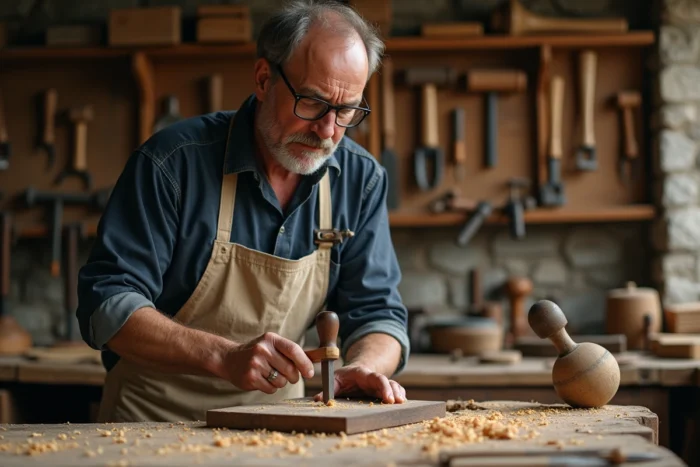
Comparing the paths that lead to cabinetry involves measuring differences in duration, cost, and opportunities between programs that do not target the same audience. The CAP remains the historical entry point, but the rise of professional retraining since 2023-2024 is reshuffling the cards: short courses for adults, Brevet des Métiers d’Art, higher diplomas in furniture design. Which paths offer the best balance between time invested and skills that can be effectively used in the workshop?
Duration and level of cabinetry training: comparative table
The choice of training depends on the entry profile. A student finishing middle school, a high school graduate, and an employee undergoing retraining do not have access to the same programs or funding.
| Training | Access Level | Duration | Mode |
|---|---|---|---|
| CAP Carpenter | End of middle school | 2 years | Full-time or apprenticeship |
| CAP Carpenter (adult in retraining) | Any level | 1 year (accelerated training) | Continuing education |
| Professional Bac in Craft and Arts (carpentry option) | End of middle school | 3 years | Apprenticeship or school |
| BMA Carpenter | CAP obtained | 2 years | Preferred alternating |
| DMA Habitat Arts | Bac or BMA | 2 years | School |
The CAP Carpenter in two years constitutes the minimum foundation recognized by the profession. It grants artisan status and allows one to set up independently. To deepen the definition and training to become a carpenter, the BMA or DMA add mastery of restoration techniques and computer-aided design, which is lacking in the CAP alone.
CAP carpenter versus short retraining: what the workshop really requires
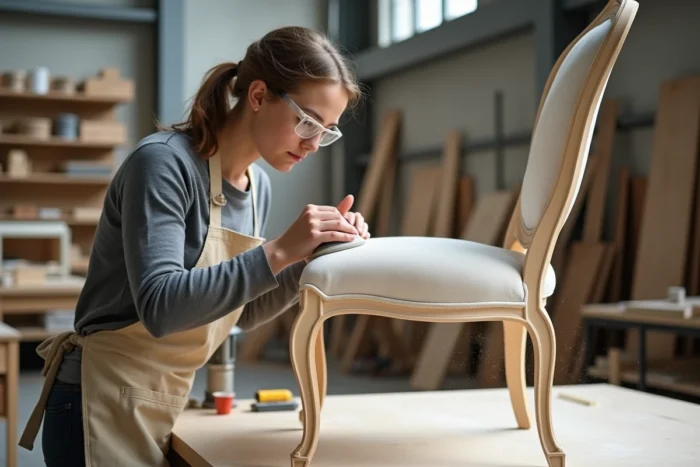
The initial two-year training in CAP alternates general education and practical workshop experience. The apprentice learns sawing, planing, veneering, assembly, and finishing (sanding, varnishing, waxing). They work with solid woods and derivatives, handle machine tools, and create plans using software.
In retraining, the CAP can be prepared in one year. The volume of hours in the workshop remains comparable, but general subjects are reduced. The technical level expected at the exam is the same, regardless of the path.
The difference lies in two concrete points:
- The mastery of machine safety, which has become a strengthened focus in wood programs. Prevention and training organizations emphasize this regulatory evolution, with specific certifications required before any autonomous use of certain equipment (band saw, spindle moulder, planer).
- The ability to read and produce a complete technical plan. A retraining profile coming from a tertiary profession often takes longer to acquire this spatial skill than a young person trained in industrial drawing since middle school.
- The professional network: two years of alternating apprenticeship creates direct links with workshops, facilitating hiring or subcontracting once established.
Salary and status upon completion of training: employed carpenter or independent artisan
A starting employed carpenter earns a salary of about 1,868 euros gross per month according to data from Onisep. This amount corresponds to the conventional minimum for a CAP holder hired in a workshop or furniture manufacturing company.
The status of independent artisan changes the game. Revenues vary according to positioning: custom contemporary furniture manufacturing, restoration of antique furniture for individuals or museums, reproduction of period pieces (Louis XV, Louis-Philippe). Heritage restoration and high-end furniture yield higher margins but require a BMA or DMA level and several years of experience.
The reform of electronic invoicing adds a new administrative constraint. Starting in September 2026, all carpenter artisans will need to be able to receive electronic invoices, and then be required to issue them starting in 2027. This obligation also applies to micro-enterprises. The choice of an approved platform and the adaptation of quotation and invoicing software represent an additional entry cost for a young person starting out.

Technical and artistic skills sought in cabinetry workshops
Job descriptions often list the required qualities in an abstract manner. What distinguishes an operational carpenter from a newly graduated one is the combination of three skill sets rarely mastered at the same level.
Manual skills and wood reading
Each type of wood (walnut, cherry, violet wood) reacts differently to sawing, gluing, and humidity variations. Knowing how to anticipate a wood’s behavior after assembly is acquired through direct experience, not through theoretical courses. Veneering thin sheets of wood to achieve straight or curved patterns requires precision to the tenth of a millimeter.
Design and technical drawing
The carpenter sketches a freehand drawing, then creates a full-scale plan on a computer, detailing all aspects: ornaments, bronze fittings, dimensions of each piece. Mastery of CAD software has become a prerequisite in most workshops, including artisanal ones.
Collaboration with other professions
The carpenter rarely works alone on a complete project. They collaborate with interior architects, designers, and sometimes marquetry artists, gilders, or wood sculptors who contribute to the decoration. The ability to communicate with these professionals and visit clients is part of the daily job.
The increase in retraining profiles since 2023-2024, driven by the search for meaningful manual jobs, does not change these requirements. It simply makes them more visible: an employee leaving an office job to enter wood training discovers a profession where the precision of the gesture is as important as the artistic vision.