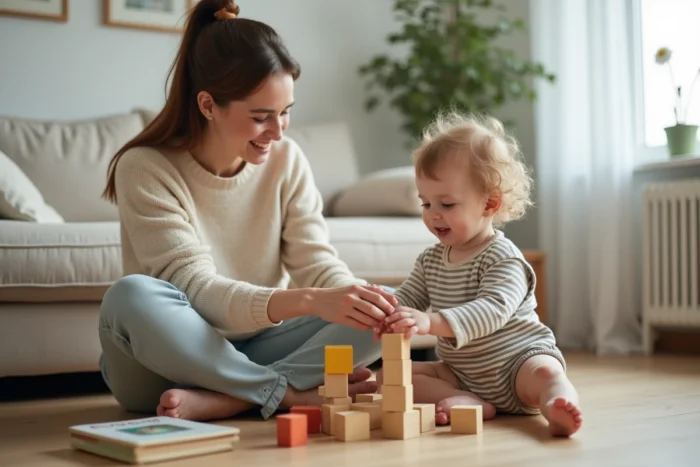
The development of a child is not measured solely by their motor or language acquisitions. The stability of their environment, the regularity of their routines, and the quality of the interactions they experience each day weigh as heavily as structured educational activities. Supporting this development on a daily basis requires understanding which factors produce measurable effects, and which are more related to widespread beliefs.
Physical environment and child development: the variables that matter
Content on parenting focuses on the attitudes to adopt (kindness, encouragement, right to make mistakes). The guide “The Keys to Childhood 0-3 Years,” published by the High Commissioner for Children in October 2025, shifts the focus. It highlights the role of the overall environment in which the child evolves: quality of collective care, stability of reference adults, coordination among early childhood professionals.
This institutional framework is not anecdotal. A child’s emotional security partly depends on the consistency of the people around them in daycare or with a childminder. When several caregivers change within a few weeks, the child loses their bearings, which can slow down language acquisition and hinder their autonomy.
The resources published around this theme of children on Maman au Quotidien detail concrete approaches to structuring this environment beyond just parental gestures.
| Factor | Impact on development | Action lever in daily life |
|---|---|---|
| Stability of reference adults | Emotional security, language | Limit changes in childcare |
| Organization of space (home, daycare) | Motor skills, exploration | Accessible objects, free play areas |
| Regularity of routines | Temporal markers, autonomy | Stable meal and sleep times |
| Unstructured free play time | Creativity, problem-solving | Reduce imposed structured activities |
| Screen exposure | Sleep, social interactions | Regulate duration and content |

Screens and digital tools: a lever for autonomy under strict conditions
Digital technology in children’s daily lives is subject to a documented paradox. Routine apps or voice assistants can support autonomy in hygiene or time organization. The digital tool helps when it structures, not when it replaces free play.
On the other hand, early and unregulated exposure to screens encroaches on three pillars of development: sleep, real interactions, and spontaneous playtime. The distinction between active use (the child manipulates, chooses, interacts with age-appropriate content) and passive use (continuous video stream) changes the game.
Criteria for digital use that supports development
- The child uses the tool voluntarily and for a limited time, with an adult nearby who can verbalize what is happening on the screen
- The content aims at a specific skill (morning routine, letter recognition) rather than passive entertainment
- Screen time never encroaches on sleep time or free play, two activities whose impact on cognitive development is better documented
Completely banning screens or allowing them without limits produces comparable results in terms of frustration and circumvention. Gradual supervision, adapted to the child’s pace, remains the most coherent approach with the available data.
Child’s choices and preferences: calibrating decisions by age
Offering choices to a child is a frequently cited lever for autonomy. The difficulty lies in calibration. A two-year-old can choose between two toys. Asking them to decide the week’s menu places them in front of a complexity that generates anxiety rather than confidence.
The number of options offered must correspond to the child’s processing capacity. Two alternatives are sufficient before three years. Three to four options become manageable around four or five years, provided they concern concrete subjects: clothing, daily activity, item to take along.
Tasks adapted to developmental stages
The progression of responsibilities follows a logic of acquired skills, not just chronological age. A child who masters standing can put objects in a bin. One who begins to verbalize their needs can express a food preference.
- Before three years: tidy up toys with an adult, choose between two pieces of clothing, participate in handwashing in a guided manner
- Between three and five years: set the table with appropriate objects, dress independently (with easy-to-put-on clothes), water a plant
- After five years: prepare a bag, follow a morning routine without constant reminders, make simple decisions about organizing their free time
The goal is not to multiply tasks but to ensure that each responsibility entrusted corresponds to a skill that the child can exercise without repeated failure. Occasional failure is part of learning. Systematic failure, on the other hand, erodes confidence.

Child’s rhythm and key moments of the day
Transition moments (waking up, leaving for school, returning home, bedtime) concentrate the majority of daily tensions. They are also the moments when the child consolidates their temporal markers and their ability to anticipate.
Ritualizing these transitions does not mean rigidifying them. A child who knows that after the bath comes storytime, then lights out, anticipates the sequence. This predictability reduces opposition because it decreases uncertainty.
Sleep and free play: two non-negotiable priorities
Sleep remains the factor most correlated with attention and emotional regulation abilities in young children. Free play, without instructions or goals imposed by an adult, allows the child to develop their creativity and ability to solve problems independently.
Protecting these two time slots in a child’s day produces more tangible effects than adding additional educational activities. A child who sleeps enough and plays freely each day has the resources to absorb the learning offered elsewhere.
The temptation to fill every slot with a structured activity (sports, music, foreign language) is based on the idea that maximum stimulation accelerates development. Current data suggest the opposite: it is unstructured time that allows the child to integrate what they have learned in a directed framework.