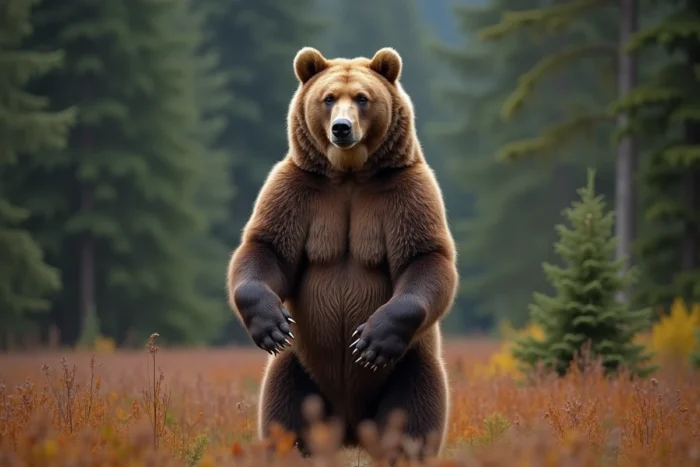
When observing an Alaskan coastal grizzly standing on its hind legs and mentally comparing it to a Pyrenean brown bear, the size difference seems to belong to two distinct species. Taxonomically, the reality says otherwise: grizzly and European brown bear belong to the same species, Ursus arctos. The size difference primarily comes from what each population eats and where it lives.
Coastal grizzly vs. interior grizzly: a gap not explained by subspecies
The debate is often reduced to “grizzly versus European brown bear,” as if each camp formed a homogeneous block. In reality, the size of a grizzly varies considerably depending on its geographical location.
Coastal grizzlies from Alaska and British Columbia, which access massive salmon runs every summer, commonly weigh between 350 and 450 kg. Some documented individuals far exceed this range. In contrast, interior grizzlies in the Rockies, deprived of this protein resource, weigh significantly less, sometimes barely more than a large European brown bear.
This internal variation shows that the size difference between grizzly and brown bear is not encoded in a subspecies genetic code but modulated by access to food and the length of the feeding season.
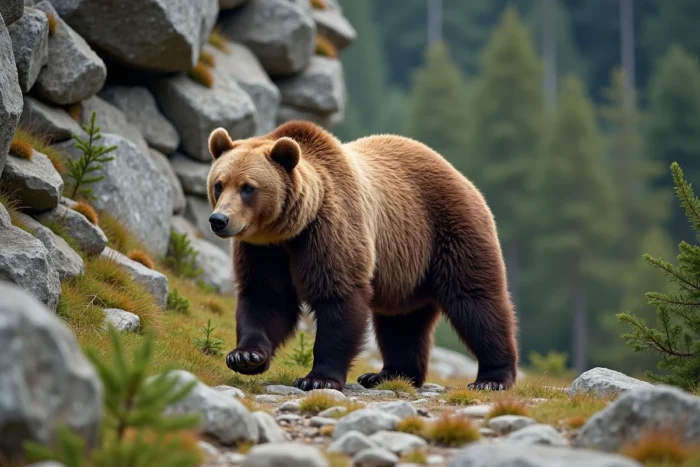
European brown bear: a size constrained by the Pyrenean and Scandinavian environment
In Europe, brown bear populations occupy fragmented habitats. In the Pyrenees, bears roam in forested territories fragmented by human activity. Their diet largely consists of vegetation, berries, insects, and occasional carcasses. No rivers teeming with salmon, no coastal meadows rich in lush grass.
Adult Pyrenean males remain modest compared to their North American counterparts. A Pyrenean male typically weighs much less than a coastal grizzly, and its shoulder height is proportionally reduced. Females are even lighter.
In Scandinavia, brown bears have larger territories and slightly better food access. Scandinavian males are on average heavier than their Pyrenean cousins but still fall short of coastal grizzlies. Thus, a size gradient is observed even within Europe.
Diet as the main variable
What separates a 150 kg bear from a 400 kg bear is primarily the amount of available animal protein before hibernation. Pacific salmon provides coastal grizzlies with a concentrated caloric intake over a few weeks, during which an individual can gain several dozen kilos of fat.
The European brown bear has no equivalent to this seasonal bounty. Its omnivorous diet, dominated by vegetation, results in slower weight gain and a less spectacular autumn weight peak.
Same species Ursus arctos: why taxonomy matters in the field
Grizzlies are often referred to as fundamentally different from brown bears. This confusion has concrete consequences, particularly in the Pyrenees, where some opponents of bear reintroduction wave the image of the grizzly to amplify the perception of danger.
The FERUS association has published a clarification on this subject: the Pyrenean brown bear is not the American grizzly. Behavior, size, and relationship to humans differ, even though genetic relatedness is close. A Pyrenean bear that encounters a hiker typically adopts a flight response in the vast majority of cases.
The taxonomic classification places the grizzly (Ursus arctos horribilis) and the European brown bear (Ursus arctos arctos) as subspecies of Ursus arctos. The difference between the two is more about ecotype than deep genetics.
The case of the Kodiak, an instructive extreme
To put it in perspective, the Kodiak bear (Ursus arctos middendorffi), isolated on the Kodiak archipelago in Alaska, represents the largest ecotype of brown bear in the world. Its size exceeds that of coastal grizzlies on the mainland. The Kodiak illustrates how far food abundance and island isolation can push size within the same species.
The European brown bear sits at the other end of this spectrum, not due to genetic inferiority, but because its living conditions do not favor the same growth.
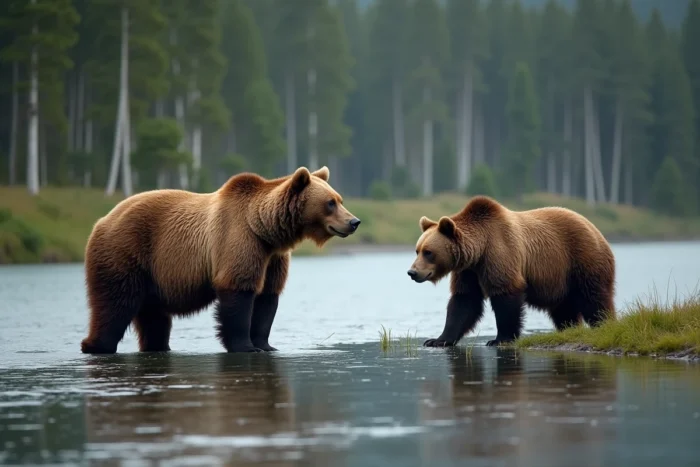
Comparing sizes: the criteria that really matter
When trying to compare a grizzly and a European brown bear, several parameters come into play beyond raw weight:
- Autumn body mass (just before hibernation), which reflects fat accumulation and constitutes the annual weight peak for both populations
- Shoulder height, which varies less than weight but is consistently higher in coastal grizzlies compared to European bears
- Total body length (from snout to base of tail), where coastal grizzlies also notably exceed European bears
- Sexual dimorphism, pronounced in both populations: males are significantly heavier and larger than females, making averages misleading if sex is not specified
Returns on this point vary according to studies and sampled populations, but the dietary factor explains most of the gap, more than genetics or latitude.
Grizzly and European brown bear in relation to humans: size and behavior do not go hand in hand
A larger bear is not automatically more dangerous. The coastal grizzly, despite its imposing mass, often lives in areas with low human density and avoids contact. The smaller Pyrenean brown bear shares its space with shepherds, hikers, and villages.
Incidents involving brown bears in Europe remain rare. The size of the animal matters less than its habituation to human presence, the availability of natural food, and the terrain configuration.
Reducing the comparison between grizzly and European brown bear to a matter of kilos overlooks what truly structures coexistence. The size gap is real, but it primarily tells the story of two environments, not of two fundamentally opposed animals.