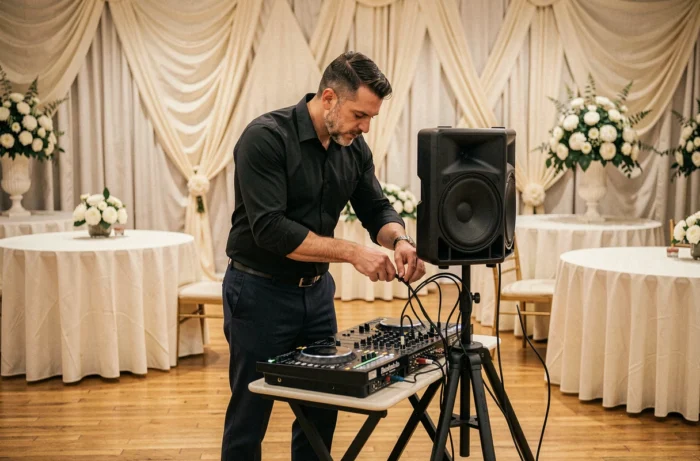
A wedding moves through three or four distinct acoustic setups in a single day. Each transition (ceremony, cocktail hour, dinner, dance floor) changes the distance between the sound source and listeners, the ambient noise level, and the regulatory constraints. Choosing a sound system for a wedding means designing a modular setup that can handle these changes without having to dismantle everything between each phase.
Impedance, cabling and latency: the factors general-interest guides overlook
The choice between active and passive speakers is about more than convenience. An active speaker has a built-in amplifier, which simplifies cabling and reduces the risk of impedance mismatch. At a wedding where equipment is moved between an outdoor ceremony and the reception venue, every additional connection point is a potential failure point.
With a passive system, the cable between the amplifier and speaker should be kept short to limit signal loss. Beyond a few metres with standard-gauge cable, the drop in level becomes audible in the high frequencies. At a venue where the sound desk is some distance from the dance floor, an active system with a line-level signal (XLR) over long distances, followed by amplification at the speaker, avoids this problem.
Latency between speakers matters too. When using two pairs positioned in different areas (one for the cocktail hour on the terrace, one for the reception room), poor timing alignment creates a noticeable echo in overlapping areas. If you’re wondering what sound system to use for a wedding across multiple spaces, the answer is a processor or digital mixer that can apply a delay to each output.
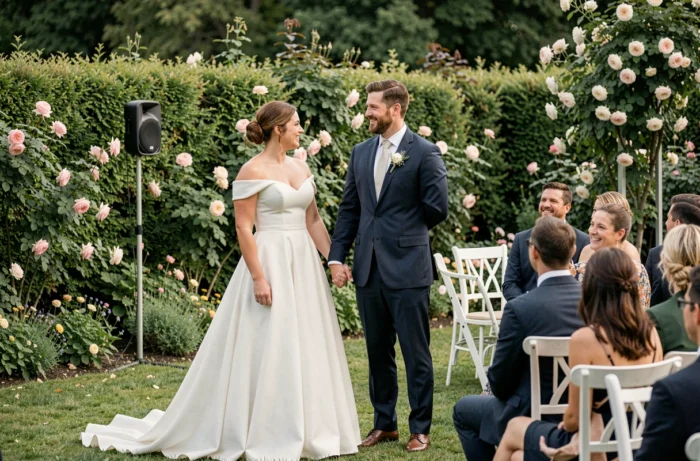
Outdoor ceremony sound systems: directivity and wind constraints
Outdoors, raw power cannot make up for poor speaker placement. Sound dissipates without walls to reflect off, so the speakers should be moved closer to the audience rather than turned up. Two compact speakers on stands, aimed at the guests with a coverage angle of around 90 degrees, will provide better coverage than a single powerful speaker placed behind the officiant.
Wind is the main enemy of outdoor microphones. A standard foam windscreen is not enough in anything more than a light breeze. We recommend using a synthetic-fur windscreen (a “dead cat”) on any lavalier or stand-mounted microphone used during the ceremony. A UHF wireless microphone remains the go-to choice for allowing the officiant and speakers to move freely.
There is no need for stage monitoring during the ceremony: it causes feedback and distracts from the proceedings. The only useful monitoring is from the mixer to the operator, through headphones.
Sound levels and regulations: what the French Public Health Code actually requires
The common belief that “you can make noise until 10 p.m.” is false. Article R. 1336-5 of the French Public Health Code prohibits noise that disturbs the peace and quiet of the neighbourhood because of its duration, repetition or intensity, by day as well as by night. An outdoor wedding at 5 p.m. with speakers poorly aimed towards neighbouring homes could expose the organisers to a fine.
For venues playing amplified sound, Decree No. 2017-1244 of 7 August 2017 sets maximum levels at every point accessible to the public, not just in front of the sound desk. Measuring the level in the middle of the dance floor and right next to the speakers will often produce two very different readings.
- Check the local municipal orders for the reception venue before finalising the sound system layout, as some municipalities impose specific time restrictions
- Aim the speakers towards the inside of the venue, not towards the property boundaries, to reduce the noise perceived by neighbours
- Use a level limiter (a compressor/limiter built into the mixer or an external processor) set to a threshold agreed with the venue manager
Complying with the legal limit for amplified sound does not automatically protect you from a noise complaint: the two sets of regulations are separate and may apply at the same time.
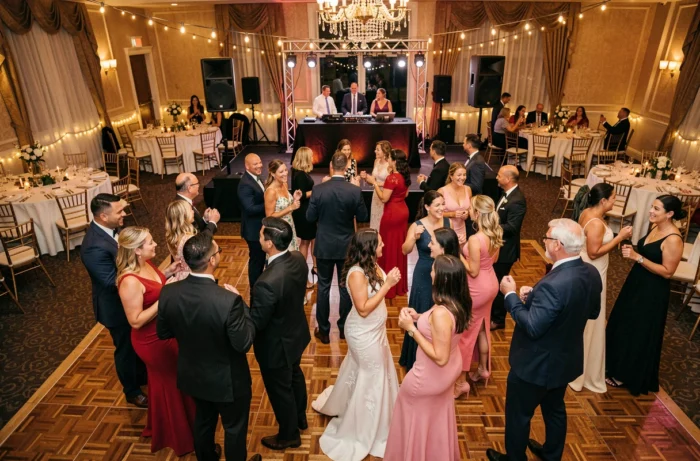
Sound equipment for the wedding reception: get the sizing right without overdoing it
On the dance floor, a subwoofer is what makes the difference between a flat atmosphere and a dance floor that really takes off. Two-way speakers (midrange and treble) struggle to reproduce frequencies below 80 Hz. A dedicated subwoofer, placed on the floor and preferably against a wall or in a corner to benefit from boundary coupling, takes the strain of the bass frequencies off the main speakers.
Oversizing the system can be just as problematic as undersizing it. A standard reception room with around a hundred guests does not need a festival line array. Speakers that are too powerful and run at low volume lose definition in the low end. The right approach is to run the system at between 50% and 75% of its rated capacity, leaving enough dynamic headroom without distortion.
Mixer and microphones for speeches
Speeches by the wedding party and newlyweds are when the sound system is most exposed. A wireless microphone with a cardioid capsule limits pickup of ambient noise and focuses on the speaker’s voice. Having two identical wireless microphones ready makes it possible to move from one speech to the next without handling the equipment.
- A compact mixer (four to six inputs) covers most needs: two microphone inputs, one line input for music, and one backup input (smartphone or USB player)
- A parametric equaliser on each microphone channel lets you cut the frequencies that cause feedback without affecting speech intelligibility
- A recorder connected to the mixer’s auxiliary output captures the speeches at a decent quality—a keepsake that is often overlooked
Testing every microphone and connection before the guests arrive is the only way to avoid unpleasant surprises. A 30-minute soundcheck in the empty room, with speakers positioned as they will be during the event, reveals feedback hotspots, level imbalances and faulty cables. On the big day, there is no second take.