When an administrative or technical service receives dozens of paper documents each day, the question is no longer whether to digitize, but how to do it without losing information in the process. Epsilon Scan Soft is a software solution designed to transform physical documents into usable files, with a focus on text recognition and integration into existing document workflows.
Multichannel Capture and Text Recognition in Epsilon Scan Soft
Most scanning tools merely produce a static image of the document. Epsilon Scan Soft goes further by combining image capture with a layer of optical character recognition (OCR). The text printed on a form, an invoice, or a letter then becomes selectable, copyable, and indexable.
Have you ever noticed that a typical scanned PDF does not allow you to search for a specific word in the document? This is exactly the problem that the integrated OCR solves. The software analyzes each page, identifies text areas, tables, and signatures, and then returns a structured file.
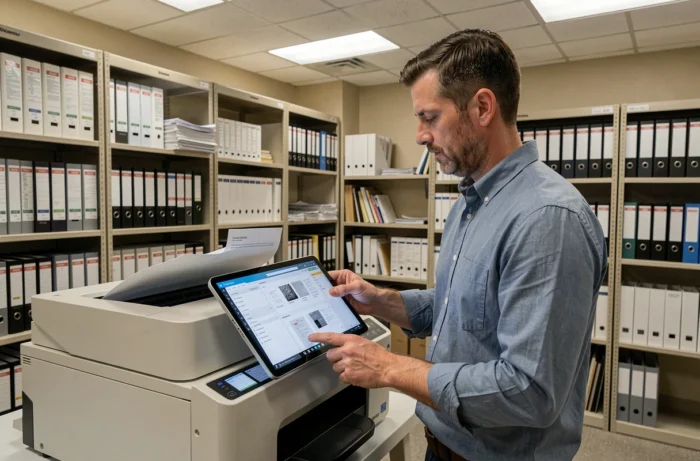
The multichannel approach means that the source of the document can vary: flatbed scanner, network multifunction device, or even import from a local folder. This flexibility allows the tool to be adapted to very different contexts, whether it is a medical office digitizing prescriptions or a municipality processing urban planning files. For everything you need to know about Epsilon Scan Soft and its capture modes, the details of the connection parameters to devices deserve careful reading.
Software Architecture and Technical Compatibility of Epsilon Scan Soft
A scanning software never works alone. It fits into an environment where an operating system, a network, a document management solution (DMS), and sometimes an ERP coexist. The question of compatibility with the existing infrastructure is therefore crucial before any deployment.
Epsilon Scan Soft operates in a Windows environment, making it accessible to the vast majority of professional workstations. It can operate in standalone mode for individual use or in network configuration when multiple users share the same scanning flow.
Connection to DMS and Archiving Systems
One of the points that differentiates a simple scanning utility from a true software brick is its ability to send scanned documents directly into a document repository. Automated export to a DMS avoids manual re-entry of metadata (date, document type, reference).
Recent archiving solutions increasingly emphasize automated retention and the immutability of documents. In this context, a capture tool that properly feeds the archiving chain from the moment of scanning reduces the risk of downstream errors.
Output Formats and Indexing
Epsilon Scan Soft produces files in common formats: PDF, PDF/A for long-term archiving, TIFF for high-resolution images. The choice of format depends on the final use:
- PDF/A is the recommended format for regulatory archiving, as it ensures that the document will remain readable without relying on specific third-party software.
- TIFF is suitable for documents containing fine graphic elements (plans, technical diagrams) where JPEG compression would degrade quality.
- Standard PDF remains the default choice for quick internal distribution, offering a good compromise between file size and readability.
Regulatory Retention and GDPR Compliance in Scanning Flows
Digitizing a document does not exempt one from adhering to retention rules. The GDPR does not impose a fixed retention period but requires that personal data be kept only as long as necessary for the declared purpose. This principle profoundly changes the way a scanning and archiving tool is configured in Europe.
Why is this point so often overlooked? Because many organizations digitize “everything” without defining a purge policy. The result: servers filled with documents that should have been deleted long ago, with a legal risk in the event of an audit.
Epsilon Scan Soft allows for associating retention metadata from the moment of scanning. The operator (or an automated profile) can assign a document category that then triggers, in the associated DMS, an appropriate retention cycle.

The Case of e-Discovery and Legal Hold
In certain sectors, the ability to freeze documents for litigation or an audit (known as “legal hold”) becomes a criterion for evaluating document solutions. If a document scanned via Epsilon Scan Soft is stored in a compliant archiving system, it can be marked as non-deletable for the duration of a procedure.
This mechanism does not depend solely on the scanning software but on the entire chain. The added value lies in the fact that the metadata injected at the time of capture facilitates later identification of the relevant documents.
Concrete Results and Anticipated Limitations
No software transforms a failing process into an efficient one. Epsilon Scan Soft provides measurable gains in the speed of processing incoming documents and the reliability of full-text search in digitized archives.
However, the quality of OCR recognition heavily depends on the quality of the source document. A handwritten form, a degraded fax, or a third-generation photocopy will produce less reliable results than a clear printed original.
- Typed documents with a standard font offer the best recognition rates.
- Hand-filled pre-printed forms often require human verification after OCR processing.
- Technical plans or documents with handwritten annotations overlaid on printed text remain a challenge for most OCR engines on the market.
Before deploying the solution, a test on a representative sample of your actual documents allows for assessing the effective recognition rate and adjusting capture parameters (resolution, contrast, automatic edge detection).
The choice of a document scanning tool often commits the organization for several years. Epsilon Scan Soft covers the expected functions of a professional capture solution, from OCR to export to a DMS, including management of archiving formats. The difference will be made on the quality of the initial configuration and the consistency between the organization’s document policy and the technical capabilities of the software.