
Support for parenting in France has long been limited to a medical aspect (pregnancy monitoring, pediatric consultations) and a social aspect (PMI, financial aid). For the past two years, public policy has integrated a third pillar, perinatal mental health, which profoundly changes the pathways offered to future and young parents.
Perinatal Mental Health: The Parenting Pathway 2025-2027
The parenting pathway launched for the period 2025-2027 explicitly refocuses public action on the mental health of parents. Early prenatal and early postnatal consultations, made mandatory in the follow-up, are no longer mere administrative formalities. They become key points for identifying anxiety disorders, postpartum depression, and attachment difficulties.
We observe that this evolution changes the stance of perinatal professionals. The lead midwife, whose status has been formalized, now ensures coordination between the primary care physician and the maternity ward, from pregnancy until the fourteenth week after birth. Her role goes beyond obstetrical follow-up: she refers to a perinatal psychologist or psychiatrist when the signals warrant it.
Multidisciplinary structures offer support that combines birth preparation, emotional support, and physical monitoring. Several centers in France, including those listed on espacerenaitre.fr, operate within this logic of a holistic approach rather than one segmented by specialty.
Non-Medical Perinatal Support: What the Concept Really Covers
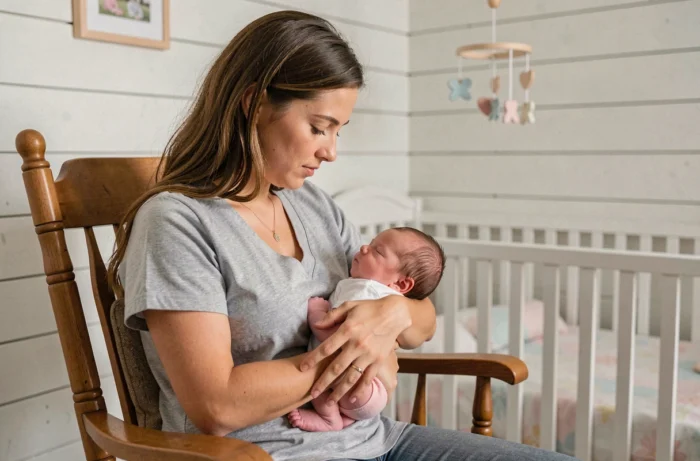
Perinatal support is not limited to medical actions. This is a point that public content rarely addresses with precision. The question posed by professionals in the field is clear: what is the use of someone who performs no medical acts in a health pathway?
The answer lies in three distinct functions:
- Support for building the parent-child bond, through workshops on carrying, massage, or gestural communication, which act on the infant’s emotional regulation and parental confidence.
- Guidance within the care network, because most young parents do not know how to differentiate the respective roles of PMI, the primary care physician, the liberal midwife, and the TISF (social and family intervention technician).
- Prevention of parental burnout, through a structured space for discussion, distinct from the circle of friends or family, where difficulties are named without judgment.
These functions do not replace medical follow-up. They fill a gap between consultations, a gap during which postpartum disorders often go unnoticed.
Parenting and Social Rights: The Retirement Decrees of July 2026
Support for parenting now extends beyond the realm of health. Two decrees published on July 29, 2026, modify the consideration of children in the calculation of retirement, particularly for female civil servants.
The decree n°2026-699 grants one quarter of a year of bonus for each childbirth that occurred since January 1, 2004, for agents under the CNRACL, provided that the birth took place after recruitment. The decree n°2026-700 allows for the consideration of up to two additional quarters related to children to facilitate access to early retirement for long careers.
The stated goal is to reduce the gaps between women and men regarding this type of retirement. For young parents, this means that interruptions or reductions in activity related to the arrival of a child weigh less heavily on their professional trajectory. We recommend that future parents check, as soon as the pregnancy is declared, the impact of these new rights on their career record.

Parenting Resources: Identifying Reliable Tools Amidst the Information Overload
The problem for young parents is no longer a lack of information. It is the excess. Among mobile applications, podcasts, newsletters, and forums, identifying a resource backed by public health data is like navigating an obstacle course.
Here are some concrete guidelines for filtering:
- The site 1000-premiers-jours.fr, supported by Santé publique France, remains the institutional reference for questions about nutrition, breastfeeding, child development, and physical environment, from conception to the child’s two years.
- Health Insurance has modernized its parenting kit with a dedicated podcast and a monthly newsletter tailored to each stage of the journey, from pregnancy to three years.
- LAEP (child-parent reception places) offer a free and no-registration-required framework to break isolation, but their territorial coverage remains uneven across departments.
A simple criterion for evaluating the reliability of a resource: check if it cites its medical sources or if it relies on an identifiable scientific committee. The absence of clear legal mentions is a warning sign.
Child Protection and PMI: A Stressed Territorial Network
Maternal and child protection centers remain the first safety net for vulnerable families. Free consultations, vaccination follow-ups, home visits, group workshops: their service offering is broad. However, the General Inspectorate of Social Affairs (IGAS) has pointed out the need to assert a public health logic in the organization of perinatal care across territories.
In practical terms, this means that the quality of support heavily depends on the department of residence. The disparities in resources between urban and rural PMIs create inequalities in access to specialized consultations, developmental assessments, and early referrals.
For parents who do not find an appropriate response in their local PMI, regional perinatal networks serve as a relay. They coordinate health professionals, social services, and associations within the same territory, aiming for continuity of care.
Parenting is built within an ecosystem of care, rights, and support whose contours are changing rapidly. The retirement decrees of 2026, the refocusing on perinatal mental health, and the increasing competence of non-medical support workers create a more complete but also more complex landscape for families to navigate.