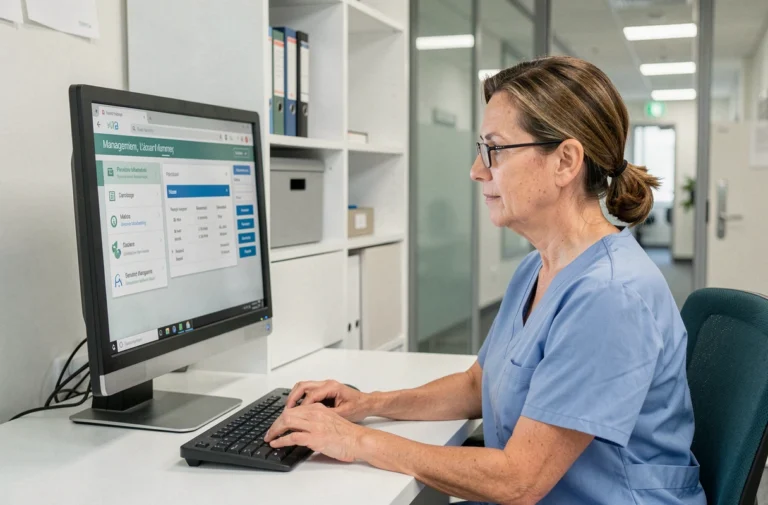
The PIA 21, the academic intranet portal of the Côte-d’Or department, concentrates access to management, training, and career tracking applications for the staff of the Dijon academy on a single interface. Its deployment raises a measurable question: to what extent does this digital gateway modify the administrative and pedagogical circuits for teachers and agents in the territory?
PIA Portal and Academic Messaging: Two Distinct Technical Layers
A common confusion is to equate the PIA with the simple ac-dijon.fr messaging system. Both tools share the same login identifier, but their functions diverge significantly.
| Criterion | Webmail ac-dijon Messaging | PIA 21 (pia.ac-dijon.fr) |
|---|---|---|
| Main Function | Sending and receiving professional emails | Unified dashboard: access to applications, circulars, HR services |
| Authentication | Academic identifier (first.last) | Same identifier, SSO portal centralizing all applications |
| Accessible Applications | Messaging only | ARENA, I-Prof, continuing education platforms, secure file transfer |
| Target Audience | All staff | National Education staff, with sections by audience (parents, partners) |
The PIA thus acts as a layer of aggregation above existing services. Before its deployment, each application required a separate login, often via different URLs. The portal groups them behind a single authentication.
To delve deeper into the integration of PIA 21 in the Dijon academy, it is essential to understand how I-Prof interacts with this portal: the consultation of the career file, transfer requests, and career appointment tracking now go through this single entry point.
Career Management via I-Prof Dijon: What PIA Changes Concretely
I-Prof remains the reference application for individual career management of teachers. Its integration into PIA 21 modifies the access pathway, not the internal functioning of the tool.
Simplified Access and Navigation
Before integration, accessing I-Prof required knowing the direct URL of ARENA and then navigating through a menu by category. The PIA places I-Prof in direct access from the dashboard, reducing the number of clicks needed.
This simplification has a concrete effect during peak demand periods. During transfer campaigns or career appointment phases, staff access their files without going through a chain of redirects.
Persistent Limitations
The portal does not resolve issues specific to I-Prof: slowness during connection peaks, dated interface ergonomics, lack of push notifications. The PIA facilitates access, but the quality of the experience still depends on each underlying application.
Continuing Education and Educational Resources on the Academic Portal
One of the challenges of PIA 21 goes beyond simple administrative management. The portal provides access to continuing education platforms, learning pathways, and academic educational resources.
- Teachers can consult the training catalog offered by the rectorate and register directly from the portal, without switching to an external site.
- Educational resources produced at the academic level (sequences, reference documents, support documents) are centralized in a dedicated space, classified by subject and school level.
- Tracking of training actions (hours completed, certificates, validated pathways) is accessible from the same dashboard as the career file.
This centralization represents a change in practices for teachers used to navigating between multiple sites. A single identifier replaces several distinct login circuits.
However, the training offer accessible via the PIA remains that defined by the academic training plan. The portal does not create new resources: it redistributes those that exist within a unified navigation framework.

DSDEN 21, 58, 71, and 89: A Portal for Four Departments with Different Realities
The Dijon academy covers four departments (Côte-d’Or, Nièvre, Saône-et-Loire, Yonne), each having its own direction of departmental services. The PIA offers direct links to each DSDEN, but the level of appropriation of the portal varies by territory.
Rural schools, numerous in Nièvre and Yonne, face connectivity constraints that limit the daily use of an online portal. In these areas, the PIA functions more as a sporadic tool (transfer campaign, consultation of circulars) than as a permanent dashboard.
Urban establishments in Côte-d’Or benefit from a more stable network infrastructure. The use of the portal tends toward a daily reflex: checking messaging, verifying rectoral circulars, accessing management tools.
This disparity raises the question of support. A centralized portal is only valuable if all staff can access it smoothly, regardless of the geographical context of their assignment.
Perspectives for the Academic Project 2023-2027
The ongoing academic project sets orientations based on the dematerialization of practices. The PIA fits into this trajectory as a technical lever, not as an end in itself.
Several avenues remain open. The addition of personalized notifications would allow teachers to receive targeted alerts (opening of a transfer campaign, new resource in their subject). Improving mobile ergonomics would make the portal usable on smartphones, a usage that is increasing among staff moving between multiple establishments.
The PIA 21 has established the framework for a single gateway for the staff of the Dijon academy. The next step is no longer about aggregating services, but about adapting the tool to the realities on the ground, especially in areas where connectivity remains a daily obstacle.