
The Prado program (Home Return Program) organizes hospital discharge by connecting the patient with city healthcare professionals. Launched in 2010 by Health Insurance, it now covers several distinct pathways, from maternity to heart failure. Eligibility depends not only on the patient’s profile but also on the hospital establishment, the relevant pathology, and prior medical validation.
Prado Pathways and Eligibility Criteria: Comparative Table
Each aspect of Prado meets specific clinical criteria. The table below summarizes the main documented pathways, their target audiences, and access conditions.
| Prado Pathway | Target Audience | Main Access Condition | Deployment |
|---|---|---|---|
| Maternity | Mothers and newborns after childbirth | Standard maternity discharge | Since 2010, widespread |
| Orthopedic Surgery | Operated patients (prosthesis, fracture) | Orthopedic surgery intervention | Since 2012 |
| Surgery (overall) | Post-surgical patients | Hospitalization for surgical procedure | Widespread since 2016 |
| Heart Failure | Patients after cardiac decompensation (NYHA stages III and IV) | Hospitalization for decompensation, medical prescription | Since 2013 |
| COPD | Patients with chronic obstructive pulmonary disease | Hospitalization related to COPD | Since 2015 |
| Stroke / TIA | Patients who have suffered a stroke or transient ischemic attack | Return home, establishment offering the pathway, medical prescription | Experimentation then extension |
The maternity pathway remains the oldest and most widely deployed. Pathways related to chronic pathologies (heart failure, COPD) have been gradually added, with specific follow-up protocols.
To better understand who can benefit from the home return assistance with the Prado program, it is essential to distinguish between criteria related to the patient and those dependent on the establishment.
Patient Criteria and Medical Validation: Two Successive Filters
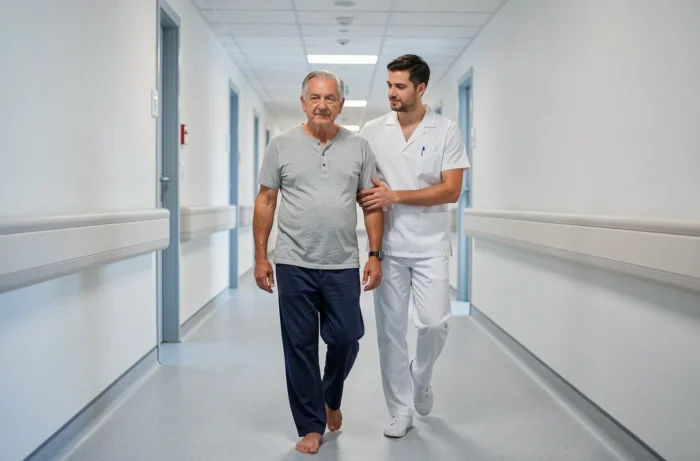
Access to Prado does not function as a simple administrative request. Eligibility is first determined by the hospital medical team, which assesses three dimensions: the patient’s health status, level of autonomy, and social context.
The patient must be socially insured (or a beneficiary) and over 18 years old for pathways outside of maternity. Participation remains voluntary: the Health Insurance advisor offers the service, but the patient can refuse.
The Role of the Doctor in the Decision
The medical team does not merely validate a diagnosis. It also specifies all the needs for city care: consultations with the attending physician, nursing sessions, physiotherapy. For the stroke pathway, for example, an explicit medical prescription is required in addition to the diagnosis.
This dual filter (clinical criteria then prescription) explains why two patients hospitalized for the same reason in two different establishments may not have the same access to Prado.
Geographical Disparities in Access to the Prado Program
A point rarely highlighted: Prado is not available in all healthcare establishments. The service is still being deployed across the territory. A hospital that does not offer the relevant pathway will not be able to direct its patients to the program, even if their clinical profile matches.
This constraint creates significant access disparities based on geographical location. A patient hospitalized for heart failure in an urban university hospital is more likely to be offered Prado than a patient treated in a rural hospital where the pathway has not yet been implemented.
The Case of Special Regimes
The program has gradually expanded beyond the general regime. Insured persons of Enim (maritime regime) and their beneficiaries can now benefit from it. The CRPCEN (Clerks of Notaries Fund) also offers Prado to its affiliates. However, actual coverage still depends on the availability of the program in the establishment where the patient is hospitalized.
Post-Hospitalization Follow-Up: Variable Protocols Depending on Pathology
The nature of the follow-up organized by Prado varies significantly from one pathway to another. This difference partly explains the distinct eligibility criteria.
- For maternity, the follow-up focuses on monitoring the mother and newborn in the days following discharge, with home visits by a midwife.
- For heart failure at NYHA stages III and IV, the protocol provides for weekly nursing sessions for two months, then biweekly for four months, up to a maximum of 15 sessions.
- For orthopedic surgery, coordination focuses on rehabilitation physiotherapy and the follow-up of dressings or post-operative care.
- For stroke, the pathway integrates a rehabilitation and re-adaptation dimension that involves several city healthcare professionals.
These structured protocols allow the Health Insurance advisor to organize care even before the patient is discharged. The advisor meets the patient during hospitalization, develops the return plan, and contacts the city providers chosen by the patient.

Integration with the Nursing Care Assessment
As of January 1, 2024, all care for dependent individuals must be billed through the BSI (Nursing Care Assessment). This change directly affects Prado patients who require extended nursing follow-up, particularly in heart failure and COPD pathways. The BSI structures the assessment of needs and conditions the billing of services, which strengthens the framework for home follow-up.
Access to Prado therefore relies on a combination of factors: the reason for hospitalization must correspond to an existing pathway, the establishment must offer the program, and the medical team must validate the patient’s eligibility. The adherence rate among eligible patients is around 80%, indicating that the majority of patients to whom the service is offered accept it. The main barrier remains less individual refusal than the inequality of territorial coverage of the program.